Category Archives: Uncategorized

Quantum Magnetoreception: The Cryptochrome Radical-Pair Mechanism in Avian Navigation

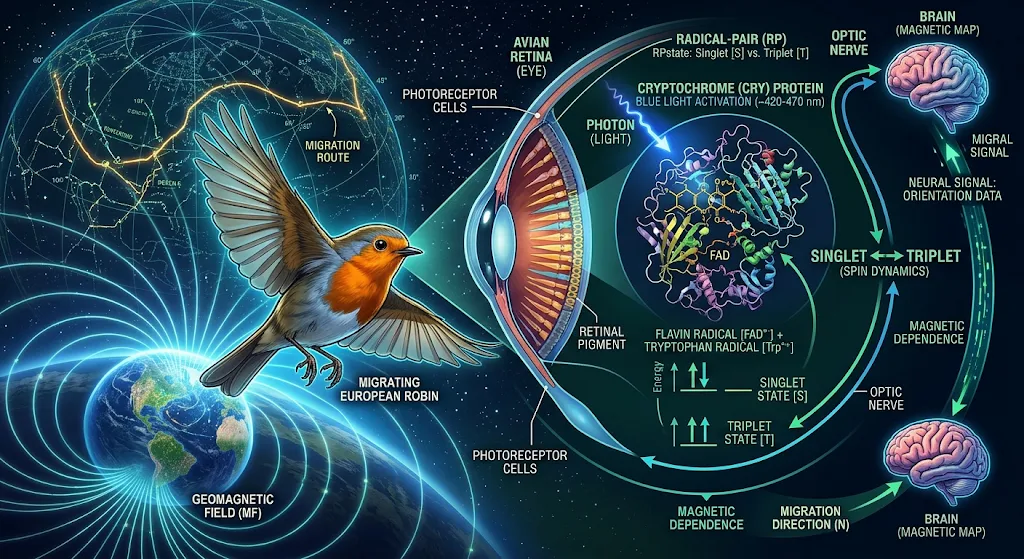
The precise biophysical orchestration underlying avian magnetoreception—the capacity of migratory avifauna to perceive the geomagnetic field vector for spatial orientation—has long challenged reductionist paradigms in sensory biology. Historically conceptualized through ferromagnetic magnetite mineralization hypotheses, contemporary biophysical consensus predominantly implicates a quantum-mechanical phenomenon known as the radical-pair mechanism (RPM), initially postulated in biochemical contexts by Schulten et al. (1978). This mechanism operates within specialized photoreceptor proteins situated within the avian retina, predominantly cryptochromes (specifically Cryptochrome 4, or Cry4), as characterized structurally and functionally by Liedvogel and Mouritsen (2010).

At the core of this transduction pathway lies photo-induced electron transfer. Upon absorption of a blue photon by the flavin adenine dinucleotide (FAD) chromophore within the cryptochrome pocket, an intraprotein electron transfer cascade ensues. An electron is sequentially shuttled along a triad or tetrad of conserved tryptophan residues, culminating in the reduction of FAD and the generation of a spatially separated radical pair: $[FAD^{\bullet-} \dots TrpH^{\bullet+}]$. Because these unpaired electrons originate from a singlet state, their initial spin multiplicity is conserved. However, the stochastic influence of internal nuclear spins—mediated primarily via hyperfine interactions with adjacent hydrogen atoms—induces rapid interconversion between singlet and triplet quantum states.

Crucially, the rate and probability of this interconversion are modulated by the orientation of the applied external geomagnetic field relative to clones or molecular axes of the radical pair, a manifestation of the anisotropic hyperfine coupling tensor. As Ritz et al. (2000) mathematically formalized, even the extremely weak microtesla intensities of Earth’s magnetic field are sufficient to perturb the quantum yield of subsequent chemical signaling states. This directional dependence alters the relative population of the spin states, shifting the biochemical equilibrium toward downstream signaling cascades that culminate in neural modulation within the visual cortex, effectively allowing migratory species to perceive geomagnetic vectors as modulations of retinal luminosity patterns.

Recent ultrafast transient absorption spectroscopy and site-directed mutagenesis studies, such as those conducted by Hiscock et al. (2016), have further corroborated the necessity of specific tryptophan structural alignments for maintaining radical pair lifetimes sufficient for geomagnetic sensitivity. The quantum coherence of these radical pairs must persist on a timescale long enough to sample the anisotropic local magnetic environment before spin relaxation or recombination neutralizes the directional asymmetry.

Ultimately, avian magnetoreception serves as an extraordinary biological exemplar of macroscopic sensory utility driven by sub-atomic quantum coherence. By translating perturbations in quantum spin multiplicity into physiological neural action potentials, cryptochromes exemplify how evolutionary pressure has harnessed sub-atomic mechanical principles to navigate planetary spatial scales.

The Greenland Acquisition?

Following is strictly political opinion and commentary:

I guess I remember hearing about how the President of The United States had been talking, at one time or the other, about acquiring Greenland as part of The United States.

This kind of talk, coming from President Trump, apparently caused a lot of commotion at home and around the globe and to some, it might have appeared that somebody with an authoritarian attitude was hell bent on going on a big political land grab and there were all kinds of voice, pro and con, about the idea.

But hell, folks, I remember that we already had some kind of military presence in Greenland even before anybody started talking about the current agreement between Greenland, The United States and the government of Denmark to allow The United States to expand their military presence in that cold and remote corner of the beleaguered world.

In my humble, albeit masterfully amazing intellectualism, it has to be concluded with anyone with half a brain and the ability to find their own ass in a mirror, that expanding military influence in a region can lead to more political influence in the region thus colonized (In a manner of speaking) and the dominant party (In this case the United States) might actually morph, by influence, politics, finances and population, into the defacto government of the region so colonized.

The thing, however, is not the immediate effects — or even the long term effects– of such a move on the part of The United States, Greenland and Denmark that matter as much as the ever-present question of deterrence in the face of negative aggression by other expansionist regimes. The problem, as I see it is, just how much deterrence can The United States be in these days when it is perceived by much of the world as being a lot more bluster and blow– in some areas — than reality—-and how far can The United States expand its global influence and still remain in control of all the circumstances involved?

These are questions for more superior intellects than mine — although, to my pufferous vanity, a more superior intellect sometimes seem to me to be a physical impossibility –but I am a legend in my own mind, so what the Hell?

Time Moves On

It is time to slip on the work clothes and to go out back and cut down all the dying flowers that I planted earlier in the season. So now we have had the blistering heat of summer, we shall prepare for the numbing coldness of the winter to come.

It is all I have heard this year, :Too damned hot or too damned cold, depending on the season… people never seem to be satisfied, do they?

Then there is the inflationary economy and people are bitching and moaning (The same as they have for at least the last 80 years) “A poor man just can’t make it in this economy anymore.” Exclusive!! — My Grandfather was saying that 70 years ago and my own Dad was saying it all the time I was growing up and everyone I knew was saying it all trough my life to the present day — and you know what? Everyone bitches about how the poor man can’t make it in the economy but, for some strange inexplicable reason, they always do manage to make it.

I do not know if that is something psychological or mathematical or spiritual or a little of all three.

But I do know and can testify that My God supplies my every need and the inflation and the economy have no negative effects on me at all …not now…not before now…not ever! I somehow seem to be able to get what I need when I need it and in the quantity that I need it and at the price that I can afford. I cannot explain this but it is a fact.

Might have something to do with residuals from the billionaire days.

If You’re an Unbeliever, You Still Don’t Have to Be Afraid of Hell — There Is An Answer — There is A Free Insurance Policy.

If you are an unbeliever, you may have heard Christians talk about hell in ways that sound frightening: believe the right things, obey the right rules, or face eternal punishment.

But there is another side of the Christian message that is often overlooked.

Christianity does not ultimately teach that people can earn their way into heaven by being good enough. At the heart of the Christian gospel is the claim that God offers forgiveness as a gift through Jesus Christ.

You may not believe in God. You may have serious questions about Christianity, the Bible, or the existence of an afterlife. Those questions are worth taking seriously. Faith should not require pretending that difficult questions do not exist.

But consider what the Bible itself actually says.

It begins with a remarkably honest assessment of humanity:

“For all have sinned, and come short of the glory of God” (Romans 3:23, KJV).

According to Christianity, the problem isn’t simply that some people are unusually bad. Every person falls short of God’s perfect standard.

Yet Christianity’s central message isn’t “Try harder.”

It is grace.

The Bible says, “For by grace are ye saved through faith; and that not of yourselves: it is the gift of God” (Ephesians 2:8).

The Christian claim is that God did something humanity could never accomplish for itself. According to the New Testament, Jesus Christ willingly went to the cross and took upon Himself the consequences of human sin.

Romans 5:8 puts it this way:

“But God commendeth his love toward us, in that, while we were yet sinners, Christ died for us.”

That is the heart of the gospel.

You don’t have to clean yourself up first. You don’t have to become religious enough. You don’t have to pretend you have no doubts.

The invitation is to investigate Jesus.

Look at His teachings. Examine His claims. Read the accounts of His life and resurrection. Ask whether the evidence gives you reason to believe that He really was who He claimed to be.

Jesus said:

“He that believeth on me hath everlasting life” (John 6:47).

Notice that Christianity presents eternal life as something received—not something achieved.

And for those who do believe, the Bible offers this extraordinary assurance:

“There is therefore now no condemnation to them which are in Christ Jesus” (Romans 8:1).

So perhaps the most important question isn’t, “Am I good enough to avoid hell?”

The Christian answer is that none of us is.

The deeper question is: Who is Jesus, and can His promise of forgiveness be trusted?

You don’t have to pretend to have all the answers today.

If you’re an atheist, start with an honest question:

“God, if You are really there, show me the truth.”

Then investigate.

Read the Bible. Ask difficult questions. Examine the evidence. Talk with Christians who are willing to discuss their faith honestly.

Christianity does not ultimately point you toward trusting in your own goodness.

It points you toward a person.

Jesus Christ.