


By John Liming
Back around 1950, when we lived in a little rented bungalow out in the country, money was mighty scarce. We were poor as church mice, but my mother had a way of making something useful out of practically nothing.
One thing I remember was Mama making her own old-fashioned lye soap.
She collected rainwater in a big barrel because rainwater was soft and worked wonderfully for washing. In those days, folks could make lye water by slowly running water through hardwood ashes, sometimes using straw or charcoal as a filtering layer. Mama used that old country knowledge, along with saved cooking grease, hog fat, and whatever other ingredients were available, to make homemade soap.
The mixture had to be handled carefully because lye was powerful stuff. But once the soap was properly made and cured, it became one of the most useful things in our little household.
We didn’t have fancy scented soaps, expensive laundry detergents, or shelves full of cleaning products.
We had Mama’s lye soap, and that was enough.
We bathed with it, washed our clothes with it, scrubbed the wooden floors, cleaned the kitchen, and tackled just about every dirty job imaginable. Mama knew how to make a little go a long way.
I can still imagine those freshly washed clothes hanging on the line, blowing in the country breeze, and those floors scrubbed clean by my mother’s hardworking hands.
Looking back after all these years, I realize something.
We may have been poor in money, but we were rich in resourcefulness, family love, and the quiet determination of a mother who never let poverty keep her from providing for her children.
That homemade soap didn’t just clean our clothes and floors. In its own humble way, it represented the love that held our little family together.
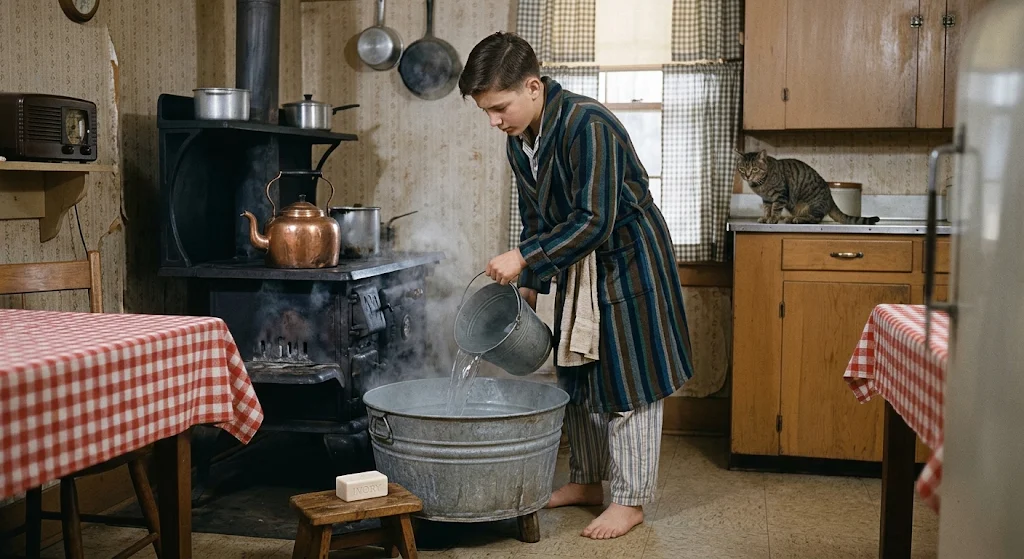
We did not have running water in our house in 1950 and our bathroom was a hundred or so feet down a path out the back door. So when I had to take my obligatory Saturday Evening bath, it was done in the old Number 10 aluminum wash tub with water drawn from a well and boiled on the old coal cookstove in the kitchen. Our whole family used the same weekly ritual with the tub– Myself, Mom, Dad and Grandfather “Pap” who roomed with us. The cat, of course, never took to the idea.

It was in 1949, I guess …. Maybe 1950, and one of my favorite things in all the world was my Mom’s fresh baked country-style biscuits made with hog lard as the shortening– a little bacon grease sometimes for flavor .. and a pot of black English tea with lots and lots of sugar.
Memories of a Simpler Time — 1949 or 1950
It must have been 1949, or maybe 1950. Times were hard, money was scarce, and we were about as poor as church mice. But Lord, how rich we were in the things that really mattered!
One of my fondest memories is waking up to the smell of Mom’s country-style biscuits baking in the oven. She made them with honest-to-goodness hog lard, sometimes adding a little bacon grease for flavor. Golden brown, tender, and delicious beyond description! Alongside them sat a steaming pot of strong black English tea, sweetened with enough sugar to make your teeth ache.
Mom worked herself nearly to exhaustion. Besides keeping house and raising us kids, she took second jobs whenever she could, just to help Dad put food on our table. There were no luxuries, no vacations, and precious little money left over for anything.
But there was always love.
Looking back across more than seventy-five years, I realize something that escaped me as a child. Those biscuits weren’t merely breakfast. They were my mother’s love, baked into something warm and wonderful by hands made tired from working so hard.
We didn’t have much of anything.
But somehow, we had everything.
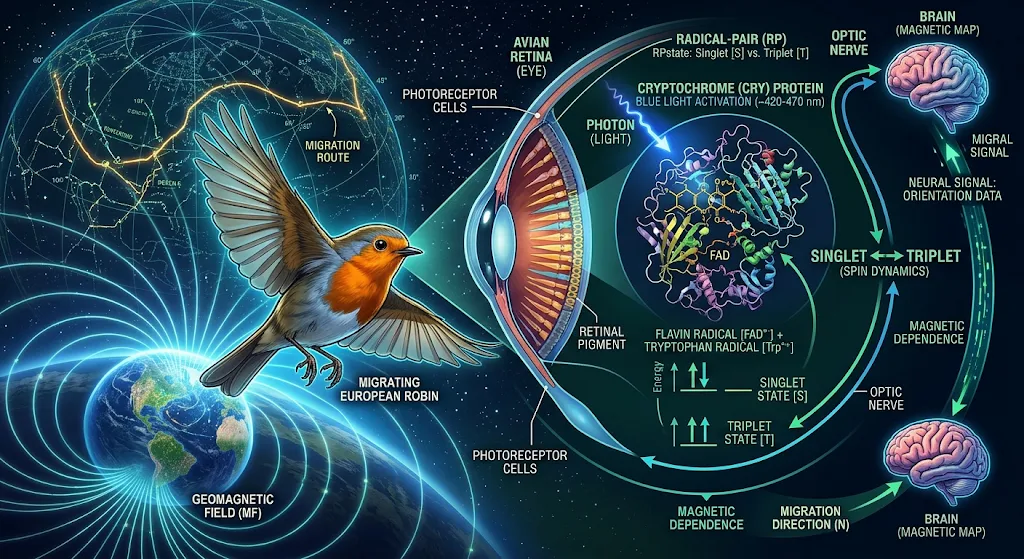
The precise biophysical orchestration underlying avian magnetoreception—the capacity of migratory avifauna to perceive the geomagnetic field vector for spatial orientation—has long challenged reductionist paradigms in sensory biology. Historically conceptualized through ferromagnetic magnetite mineralization hypotheses, contemporary biophysical consensus predominantly implicates a quantum-mechanical phenomenon known as the radical-pair mechanism (RPM), initially postulated in biochemical contexts by Schulten et al. (1978). This mechanism operates within specialized photoreceptor proteins situated within the avian retina, predominantly cryptochromes (specifically Cryptochrome 4, or Cry4), as characterized structurally and functionally by Liedvogel and Mouritsen (2010).
At the core of this transduction pathway lies photo-induced electron transfer. Upon absorption of a blue photon by the flavin adenine dinucleotide (FAD) chromophore within the cryptochrome pocket, an intraprotein electron transfer cascade ensues. An electron is sequentially shuttled along a triad or tetrad of conserved tryptophan residues, culminating in the reduction of FAD and the generation of a spatially separated radical pair: $[FAD^{\bullet-} \dots TrpH^{\bullet+}]$. Because these unpaired electrons originate from a singlet state, their initial spin multiplicity is conserved. However, the stochastic influence of internal nuclear spins—mediated primarily via hyperfine interactions with adjacent hydrogen atoms—induces rapid interconversion between singlet and triplet quantum states.
Crucially, the rate and probability of this interconversion are modulated by the orientation of the applied external geomagnetic field relative to clones or molecular axes of the radical pair, a manifestation of the anisotropic hyperfine coupling tensor. As Ritz et al. (2000) mathematically formalized, even the extremely weak microtesla intensities of Earth’s magnetic field are sufficient to perturb the quantum yield of subsequent chemical signaling states. This directional dependence alters the relative population of the spin states, shifting the biochemical equilibrium toward downstream signaling cascades that culminate in neural modulation within the visual cortex, effectively allowing migratory species to perceive geomagnetic vectors as modulations of retinal luminosity patterns.
Recent ultrafast transient absorption spectroscopy and site-directed mutagenesis studies, such as those conducted by Hiscock et al. (2016), have further corroborated the necessity of specific tryptophan structural alignments for maintaining radical pair lifetimes sufficient for geomagnetic sensitivity. The quantum coherence of these radical pairs must persist on a timescale long enough to sample the anisotropic local magnetic environment before spin relaxation or recombination neutralizes the directional asymmetry.
Ultimately, avian magnetoreception serves as an extraordinary biological exemplar of macroscopic sensory utility driven by sub-atomic quantum coherence. By translating perturbations in quantum spin multiplicity into physiological neural action potentials, cryptochromes exemplify how evolutionary pressure has harnessed sub-atomic mechanical principles to navigate planetary spatial scales.

